
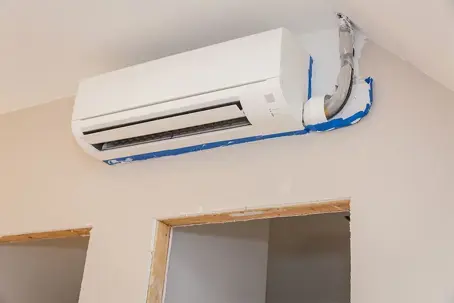
Virginia Beach presents a specific climate challenge for homeowners. The summers are long and humid, and winter brings enough cold days that heating cannot be an afterthought. Mini split systems handle both functions efficiently without requiring ductwork, making them a practical fit for homes across the area, from older cottages near the Oceanfront to newer builds in the Centerville and Great Neck corridors. But a mini split that is improperly installed underperforms from day one, and the problems that follow are often costly. During our service calls throughout Virginia Beach, we regularly see the consequences of rushed or unqualified installations.
The Benefits of Mini Splits for Virginia Beach Homes
Mini split systems are well-suited to Virginia Beach’s climate in several specific ways. Their ability to provide both heating and cooling from a single unit is practical in a region where both demands are real across a nine-month stretch of the year. Our Virginia Beach air conditioning services include mini-split installations across all major brands, and homeowners consistently report improved comfort and lower utility costs after switching from older central systems or window units.
Zoned Comfort
Mini splits allow individual rooms or zones to be controlled independently. A bedroom occupied overnight does not need to be conditioned to the same level as common areas during the day. That flexibility reduces energy consumption without sacrificing comfort in the spaces actually in use.
Energy Efficiency
Inverter-driven compressors adjust their output in response to real-time demand rather than cycling fully on and off like conventional systems. This continuous modulation maintains more stable temperatures while consuming less energy overall. In Virginia Beach, VA, where the cooling season runs roughly from May through October, that efficiency difference adds up meaningfully to monthly utility bills.
No Ductwork Required
Homes without existing ductwork or with deteriorated or poorly maintained ductwork benefit particularly from mini-splits. Duct losses in a conventional forced-air system can account for a significant portion of total energy consumption. A mini split eliminates that loss entirely by delivering conditioned air directly to the space being served.
Compact and Flexible Placement
Indoor units can be wall-mounted, ceiling-recessed, or floor-mounted depending on the room’s layout and the homeowner’s preference. That flexibility makes mini splits viable in spaces where conventional HVAC equipment cannot be installed without major structural modifications.
Why DIY Installation Leads to Problems
Mini split installation involves refrigerant handling, electrical work, and precise mechanical connections, all of which require licensed, trained technicians. Despite the appearance of accessibility, the consequences of improper installation surface quickly and are often expensive to correct.
The Most Common DIY Failures
- Refrigerant leaks from improperly flared connections: Refrigerant line connections require specific tools, torque specifications, and techniques to seal correctly. A connection that appears tight but was not properly prepared will leak, reducing system efficiency and eventually requiring a full refrigerant recovery and recharge in addition to the connection repair.
- Incorrect unit sizing: Selecting a unit based on general square footage guidelines without accounting for ceiling height, insulation quality, window area, sun exposure, and occupancy patterns results in a system that is either too large or too small. An oversized unit short-cycles, failing to manage humidity effectively. An undersized unit runs continuously without reaching the setpoint.
- Electrical hazards: Mini splits require dedicated circuits with specific amperage ratings. Improper wiring creates fire risk, trips breakers repeatedly, and can void the manufacturer’s warranty entirely.
- Poor outdoor unit placement: The condenser unit needs adequate clearance, proper drainage, and protection from direct debris exposure. Placement that ignores these requirements accelerates wear and reduces efficiency.
What Improper Installation Costs Over Time
The upfront savings of a DIY installation typically disappear within the first one to two years through reduced efficiency, accelerated component wear, and repair costs that a proper installation would have prevented. Our mini split repair work in Virginia Beach, VA, regularly involves correcting installation errors that have compounded into more significant system problems.
Key Factors When Choosing a Technician
The quality of a mini split installation depends directly on the qualifications and experience of the technician performing it. Not all HVAC contractors have the same level of expertise with mini-split systems, and the differences matter.
What to Evaluate
- Licensing and refrigerant certification: Technicians handling refrigerant must hold EPA Section 608 certification. A licensed HVAC contractor operating in Virginia must also hold appropriate state licensing. Confirming both before any work begins is a baseline requirement.
- Experience with the specific system type: Mini splits from different manufacturers have distinct installation requirements. A technician familiar with the brand being installed works more efficiently and is better equipped to optimize the setup for the specific unit’s performance characteristics.
- Warranty on labor: A technician confident in their work backs it with a labor warranty. At Hats Off Heating and Cooling, every new installation includes a 2-year labor warranty as standard.
- Transparent, upfront pricing: Flat-rate pricing with no hidden fees is the standard a trustworthy contractor follows. A detailed written estimate before work begins is a reasonable expectation.
- References and reviews: Consistent positive reviews from verified customers over an extended period reflect reliable service quality more accurately than any individual claim.
Understanding the Installation Process
A professional mini split installation follows a deliberate sequence that directly determines how well the system performs over its service life.
What the Process Involves
The installation begins with a site assessment that evaluates room dimensions, insulation conditions, sun exposure, existing electrical infrastructure, and the most practical routing for refrigerant lines. This assessment drives the sizing recommendation, which must account for the space’s actual thermal load rather than relying on general rules of thumb.
Once the unit is selected, installation proceeds through:
- Mounting the indoor unit at the correct height and orientation for optimal airflow distribution across the space
- Positioning the outdoor condenser with adequate clearance on all sides, proper drainage slope, and protection from debris accumulation
- Routing and insulating refrigerant lines through the wall penetration with correct bending radii to avoid flow restrictions
- Making refrigerant connections with properly flared fittings torqued to specification
- Completing dedicated electrical connections to the correct circuit amperage
- Pressure testing the refrigerant circuit before charging to confirm there are no leaks
- Commissioning the system and verifying performance against the manufacturer’s specified operating parameters
Each step in this sequence affects the outcome. Shortcuts at any point create problems that compound over the life of the system.
How Proper Installation Enhances Efficiency and Comfort
The performance gap between a properly installed mini split and one that was rushed or improperly configured is significant and measurable. It shows up in energy bills, in how consistently the space reaches and holds the target temperature, and in how long the system operates before requiring service.
Efficiency Starts at Installation
Refrigerant charge level, line set length, and electrical supply quality all affect the system’s efficiency. A unit running with a slightly low refrigerant charge due to a small installation leak works harder to achieve the same output, consuming more energy and stressing the compressor. A line set that was bent too sharply restricts flow, reducing capacity. These are not dramatic failures. They are subtle inefficiencies that persist throughout the life of the system if left uncorrected.
Comfort Depends on Correct Sizing and Placement
A unit that is properly sized and positioned delivers consistent temperatures across the served space without the hot and cold spots that result from inadequate capacity or poor airflow distribution. Virginia Beach’s humidity adds another dimension to this. A correctly sized system removes moisture effectively during the cooling cycle, which is as important to indoor comfort as the temperature itself during the summer months.
Staying current with mini-split maintenance after installation preserves performance over time. Filter cleaning, coil inspection, and refrigerant level verification, performed annually, keep the system operating at the efficiency level it was designed to deliver.
When Professional Installation Pays for Itself
The value of professional mini-split installation lies not just in avoiding the problems associated with improper installation. It is in the cumulative return on a system that operates efficiently, reliably, and at its designed capacity from the first day of operation through the end of its service life. In Virginia Beach’s climate, where the system will be called on for both heating and cooling across most of the calendar year, that return is substantial.

When You’re Ready to Get It Done Right
Professional installation is not a premium add-on. It is the foundation that determines whether a mini split system delivers the comfort and efficiency it is capable of. Hats Off Heating and Cooling brings the licensing, experience, and field-tested process to every installation to ensure a solid foundation. If you are considering a mini split for your Virginia Beach home, contact our team today to schedule a professional assessment and get an honest recommendation on the right system for your space.